
What Is Vibe Coding, Why to Vibe Code, and How to Vibe Code
A clear look at how AI is changing the way software gets built

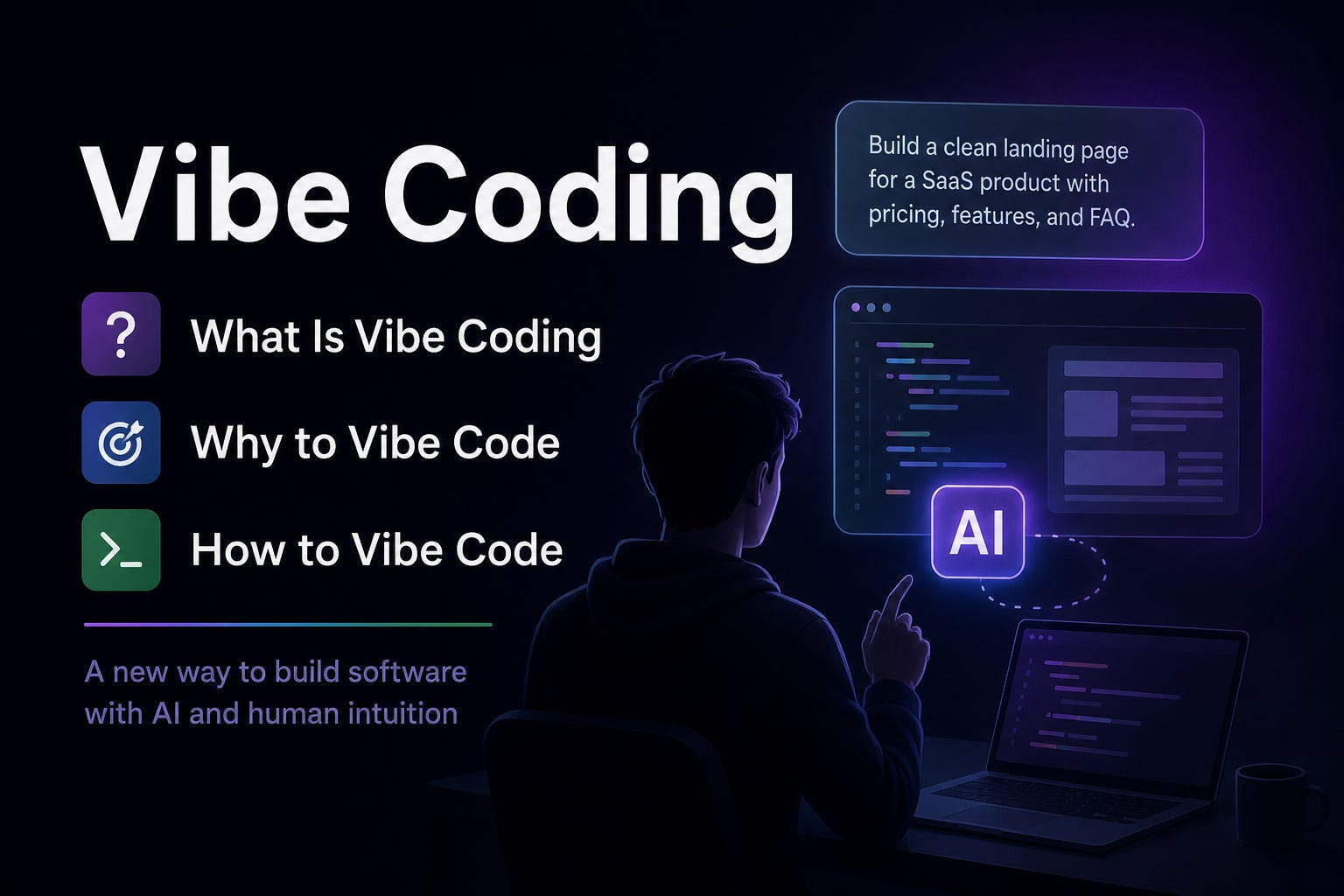
Vibe coding is a way of building software where you describe what you want in natural language, and an AI system generates the code for you. Instead of writing every line manually, you guide the system through conversation and refine the output step by step.
It sounds informal, but it reflects a serious shift in how software is created.
For decades, software development meant one thing: writing precise instructions for a machine to execute. Every function, every condition, every edge case had to be explicitly defined by a developer. That made programming powerful, but also slow and highly specialized.
That model is changing.
With modern AI systems, software is increasingly produced rather than manually written. Developers describe intent, generate a working system, and refine behavior through feedback instead of direct code control.
This is what people call vibe coding.
What is Vibe Coding
Vibe coding is a workflow where:
you describe what you want the software to do
AI generates an initial working version
you improve it through iterative feedback in natural language
Instead of building systems line by line, you steer them toward the desired outcome.
Code still exists, but it is no longer the main interface of creation.
The primary interface becomes intent.
Why Vibe Coding Exists
Vibe coding only became possible because three things changed at the same time.
First, AI models became capable of generating complete working systems, not just small code snippets.
Second, the cost of iteration dropped significantly. You can now generate multiple versions of a system in minutes and compare outcomes instantly.
Third, development tools shifted from traditional IDE workflows to conversational environments like ChatGPT, Cursor, GitHub Copilot, and Replit AI.
Together, these changes remove the need for full manual construction in many use cases.
How to Vibe Code
Vibe coding is not random prompting. It follows a simple loop.
You start by clearly defining intent instead of architecture. You describe what the system should do, not how it should be built.
Then you generate a working baseline, even if it is imperfect.
Next, you test it immediately and observe what is wrong or missing.
Then you refine it through natural language instructions such as:
“improve this behavior”
“fix this issue”
“make this more stable”
“add persistence”
Each iteration brings the system closer to the desired outcome.
In practice, you are not writing software from scratch. You are converging on it.
Where Vibe Coding Works
Vibe coding works best in environments where speed and iteration matter more than strict correctness.
This includes:
prototypes
MVPs
internal tools
UI-based applications
automation scripts
In these cases, fast exploration is more valuable than perfect structure.
Where It Breaks
Vibe coding becomes difficult in systems that require:
strict correctness
high reliability
large-scale architecture
safety guarantees
long-term maintainability
In these environments, uncontrolled generation can introduce hidden complexity or subtle errors that are hard to detect.
Why This Is a Paradigm Shift
The real change is not that coding became easier.
The change is that software creation is shifting from deterministic construction to probabilistic generation.
Before, developers wrote explicit instructions and controlled every step of execution.
Now, developers define constraints and guide a system that generates behavior.
This moves the bottleneck from implementation to specification.
The key skill is no longer writing correct syntax.
It is defining correct intent clearly enough that a system can reliably produce the right outcome.
Final Thought
Vibe coding is not a tool or a trend.
It is an early stage of a different way software is created.
The shift is simple but fundamental: software is moving from being written to being generated, from being constructed line by line to being shaped through intent and iteration.
Code is no longer the primary unit of creation.
That role is slowly shifting toward specifications, constraints, and feedback loops.
And once that shift stabilizes, building software will be defined less by what you can write, and more by what you can clearly define.
This change has only just begun.